WELCOME TO MY WORLD


My World Is Crazy !! You Wil Like It !!


Friday, July 8, 2011

Sultan Champa


Common name: Beauty Leaf, Alexandrian laurel • Hindi: सुलतान चम्पा Sultan Champa • Marathi: सुरंगी Surangi • Sanskrit: नाग चम्पा Nag champa , पुन्नाग Punnaga • Tamil: புன்னை punnai
Botanical name: Calophyllum inophyllum Family: Clusiaceae (Garcinia family)
Sultan Champa is a beautiful large evergreen tree native to southern coastal India, East Africa, Malaysia and Australia. It is a low-branching and slow-growing tree with a broad and irregular crown. It usually reaches 8 to 20 m in height. The tree supports a dense canopy of glossy, elliptical leaves. The very fragrant white flowers are 25 mm across and occur in racemose or paniculate inflorescences consisting of 4 to 15 flowers. The flowers have snow-white petals with a thick center of yellow stamens. The fragrant flowers have been prized as an adornment and as a perfume. The fruit (the ballnut) is a round, green drupe reaching 2 to 4 cm in diameter and having a single large seed. When ripe, the fruit is wrinkled and its color varies from yellow to brownish-red. This tree often grows in coastal regions as well as nearby lowland forests. However it has also been cultivated successfully in inland areas at moderate altitudes.

Dutch Honeysuckle


Common name: Honeysuckle, Dutch Honeysuckle, Madhumati (Manipuri)
Botanical name: Lonicera periclymenum 'Serotina' Family: Caprifoliaceae (honeysuckle family)
The gorgeous flowers of Dutch honeysuckle are extremely fragrant and well-loved by hummingbirds. The natural form has white flowers, but Serotina is white and dark red. As nice as the individual flower is though, it is the overall effect of the flowering vine with it's cascading layers of flowers that make it such a sight.

Japanese Honeysuckle


Common name: Japanese Honeysuckle, Madhumati (Manipuri)
Botanical name: Lonicera japonica Family: Caprifoliaceae (honeysuckle family)
The Japanese Honeysuckle is a species of honeysuckle native to eastern Asia including Japan, Korea, northern and eastern China, and Taiwan. It is a twining vine able to climb up to 10 m high or more in trees, with opposite, simple oval leaves 3-8 cm long and 2-3 cm broad. The flowers are attractive and very fragrant, but the vine is extremely invasive. The flowers, which turn from white to yellow as they age, first appear in early May and continue intermittently through fall. They are popular nectar sources for bees, butterflies and humans. The Manipuri name Madhumati is indicative of that. The fruit is a globose dark blue berry 5-8 mm diameter containing numerous seeds.

Amaltas


Common name: Amaltas, Golden shower tree, Indian Laburnum • Hindi: अमलतास Amaltas • Manipuri: চহুঈ Chahui • Tamil: கொன்றை Konrai • Malayalam: Vishu konnai • Marathi: बहावा Bahava • Mizo: Ngaingaw • Bengali: সোনালী Sonali, Bandarlati, Amultas • Urdu: املتاس Amaltas
Botanical name: Cassia fistula Family: Caesalpiniaceae (Gulmohar family)
his native of India, commonly known as Amaltaas, is one of the most beautiful of all tropical trees when it sheds its leaves and bursts into a mass of long, grape-bunches like yellow gold flowers. A tropical ornamental tree with a trunck consisting of hard reddish wood, growing up to 40 feet tall. The wood is hard and heavy; it is used for cabinet, inlay work, etc. It has showy racemes, up to 2" long, with bright, yellow, fragrant flowers. These flowers are attractive to bees and butterflies. The fruits are dark-brown cylindrical pods, also 2' long, which also hold the flattish, brown seeds (up to 100 in one pod) These seeds are in cells, each containing a single seed. A postal stamp was issued by the Indian Postal Department to commemorate this tree.
Medicinal uses: The sweet blackish pulp of the seedpod is used as a mild laxative

Night Blooming Cereus


Common name: Night Blooming Cereus, Queen of the Night, Lady of the night, Brahma Kamal ब्रह्म कमल (Hindi)
Botanical name: Hylocereus undatus Family: Cactaceae (cactus family)
Night-Blooming Cereus is probably native to the American tropics. The stems are 3-winged and green with wings that are 1 to 2 inches wide. Areoles are about 1 ½ inches apart with 1 to 5 spines to 1 cm long. They climb by use of aerial roots and can reach a height 30 feet or more growing on rocks and trees. As indicated by the name, the blooms appear at night and soon close after the day starts. In late spring to early summer the very large white fragrant flowers adorn the plant. Individual flower are 14 inches long by 12 inches across and very showy. If pollinated, they produce edible red fruits up to 5 inches long.

Orchid Cactus


Common name: Orchid cactus, Jungle cactus, Night blooming cereus, Dutchman's Pipe • Marathi: ब्रह्मकमल Brahma kamal
Botanical name: Epiphyllum oxypetalum Family: Cactaceae (cactus family)
Epiphyllum oxypetalum is by far the most popular and widely cultivated species from this genus of cacti. Orchid cactus blooms at night, since the flowers are predominantly pollinated by bats and large moths. They have large white star-like flowers to help their pollinators locate the blossoms by moon or star light, and many have very lovely fragrances. Pure white flowers, the size of a dinner plate, open as soon as the sun goes down and stay open all night, closing in the morning. Stems are erect, climbing or sprawling, profusely branched, primary stems cylindrical, to 2-6 m long, flattened laterally. Secondary stems (which look like leaves) are flat, elliptic-acuminate, to 30 cm x 10-12 cm, thin; margins shallowly crenate and wavy. Flowers are produced from flattened portions, to 30 cm long, 12-17 cm wide, nocturnal, very fragrant. Fruit is oblong, 12 x 8 cm, purplish red, angled. Epiphyllums are indeed true cacti, but are more often labeled as "Epicacti" or "jungle cacti" to differentiate them from related desert flora. Many plant lovers also call them "orchid cacti" because of the very large and colorful flowers. The great size and shape of the flowers, as well as their often intoxicatingly sweet fragrance, comes from the wild Epiphyllum genes, but the amazing colors mostly come from other cactus genera that have been cross-bred into the hybrid epiphyllums.

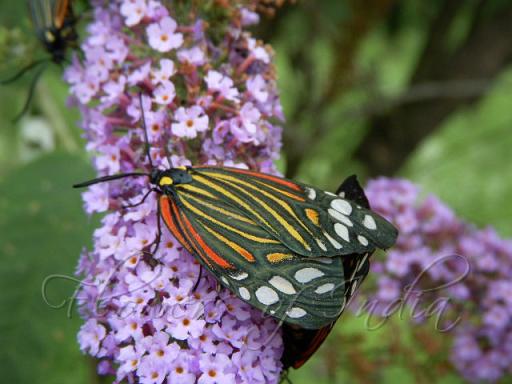
Butterfly Bush


Common name: Butterfly bush, Summer lilac
Botanical name: Buddleja davidii Family: Buddlejaceae (Butterfly bush family)
This plant is commonly called butterfly bush because of the hordes of butterflies (and bees) that are attracted to its wonderfully fragrant flowers. Butterfly bush is a deciduous to semi-evergreen shrub with a weeping form that can get 6-12 ft tall and have a spread of 4-15 ft. Butterfly bushes have opposite, 6-10 in, lance-shaped gray-green leaves on long arching stems. The tiny flowers are irresistible to butterflies. They are borne in long, 8-18 in, cone-shaped clusters that droop in a profusion of color and stay abuzz with winged, nectar-feeding insects from late spring until first frost in autumn. The flower clusters can be so profuse that they cause the branches to arch even more. The flowers of many cultivars are sweetly fragrant. Flower colors may be purple, white, pink, or red, and they usually have an orange throat in the center.